
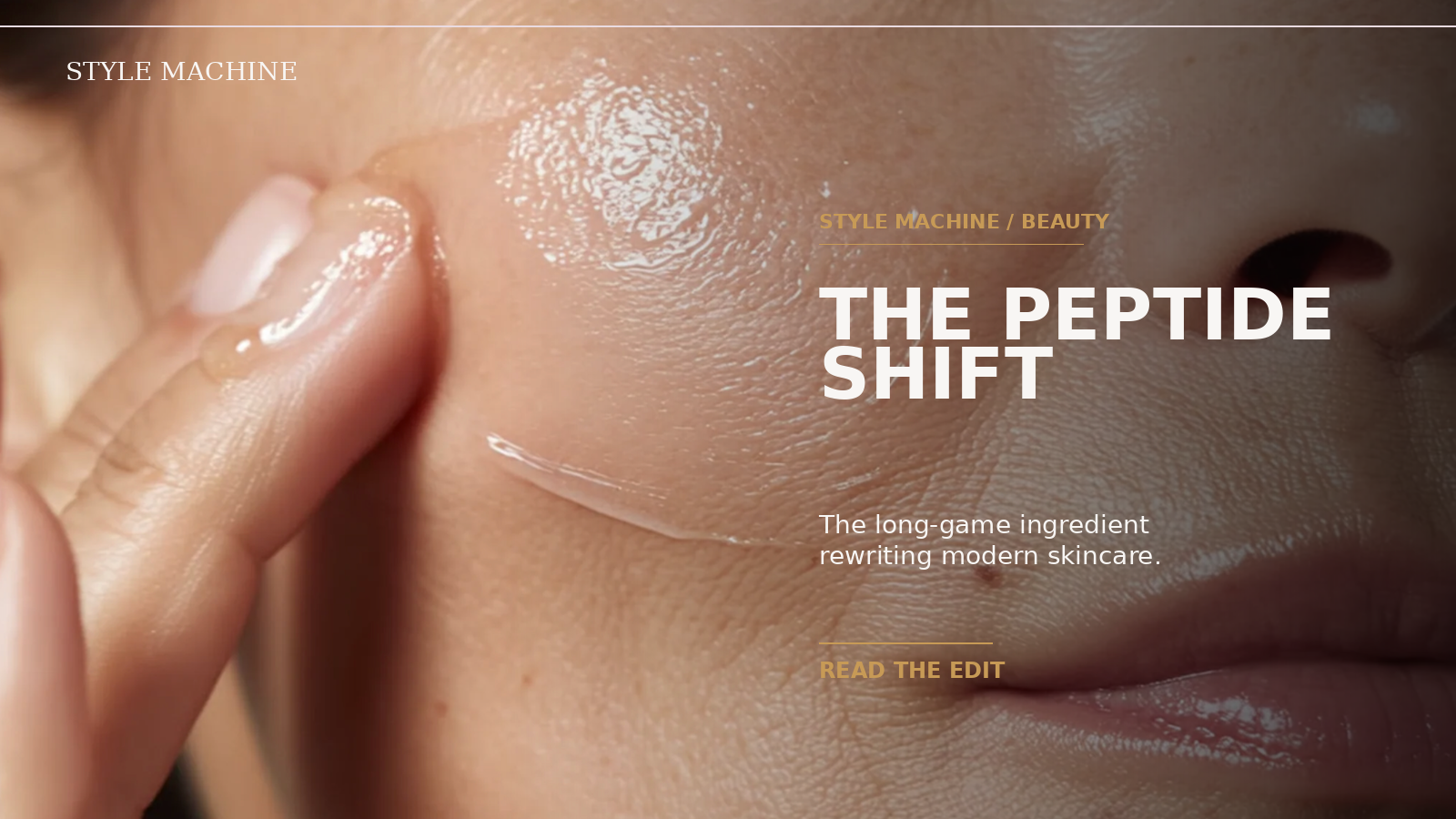
Peptides have long held a place in clinical skincare, but today they are being recognised in a new way. Once seen as a supporting ingredient, they are now emerging as one of the most intelligent tools in modern skincare, valued for their ability to support the skin’s natural function rather than force rapid change. In this Style Machine piece, April Brodie explains why peptides are finally having their moment, as the industry shifts away from harsh, inflammatory treatments and towards longevity, balance and skin optimisation. With stronger formulations, better clinical backing and a more considered approach to skin health, peptides are proving that subtle, consistent support can deliver meaningful results over time.

Peptides are being positioned as the “quiet achievers” of skincare — what’s actually changed?
Peptides have been part of clinical skincare for decades, but what’s changed is the quality of formulation and the broader shift in how we approach skin health.
We’re now seeing better-characterised peptides with genuine clinical backing, particularly signal peptides like palmitoyl pentapeptide-4 and carrier peptides such as copper peptides, which have demonstrated measurable improvements in wrinkle depth and overall skin quality.
At the same time, the industry has moved away from aggressive, inflammatory treatments towards longevity and optimisation. Peptides align perfectly with that shift. Rather than forcing the skin to respond, they communicate with it, and that subtlety is exactly why they’re now in the spotlight.
Where do peptides sit between visible results and long-term skin health?
Peptides sit firmly in the long-term skin health category.
Unlike acids or retinoids, which accelerate cell turnover and can deliver faster visible change, peptides work by signalling fibroblasts to produce collagen, elastin, and other structural components of the skin.
Clinical studies show improvements in wrinkle depth and firmness over approximately 8 to 12 weeks with consistent use. The results are more progressive, but they’re typically more balanced, less inflammatory, and more sustainable over time.

Can peptides replace hero ingredients, or are they better as support?
Peptides are best understood as intelligent support rather than replacements.
They don’t compete with ingredients like retinoids or vitamin C, instead, they enhance overall skin function around them. Clinically, they help maintain barrier integrity, reduce irritation, and optimise outcomes when used alongside more active ingredients.
In sensitive or compromised skin, peptides can take on a more central role. However, in most cases, they perform best within a well-edited routine rather than as a standalone hero.
What separates a high-performing peptide product from one driven by marketing?
This is where the real distinction lies. Not all peptides are equal, and not all are used at clinically meaningful levels.
A high-performing peptide product typically includes:
- Well-studied peptides such as palmitoyl pentapeptide-4 or copper tripeptide-1
- Evidence-based concentrations
- Stability within the formulation
- A delivery system that ensures the peptide remains active and reaches its target
There is also strong rationale for combining different classes of peptides, such as signal and carrier peptides, to enhance results. Without this level of formulation integrity, results are often minimal.
How are clients misusing or misunderstanding peptides?
The most common misconception is expecting immediate, dramatic results.
Peptides work gradually, with improvements that are subtle and cumulative rather than instant. This often leads to them being underestimated.
Another issue is overcomplicating routines. Layering peptides with too many competing actives can dilute their effectiveness or compromise the skin barrier.
In practice, peptides perform best within a considered routine where the skin is supported, not overwhelmed.
What should first-time users prioritise to see real results?
Consistency is key.
Clinical evidence shows peptides require regular use over several weeks to deliver measurable improvements in firmness, wrinkle depth, and overall skin quality.
The most effective approach is to choose one well-formulated product and commit to it. When used consistently, peptides can significantly improve overall skin health and longevity.




Leave a Reply