
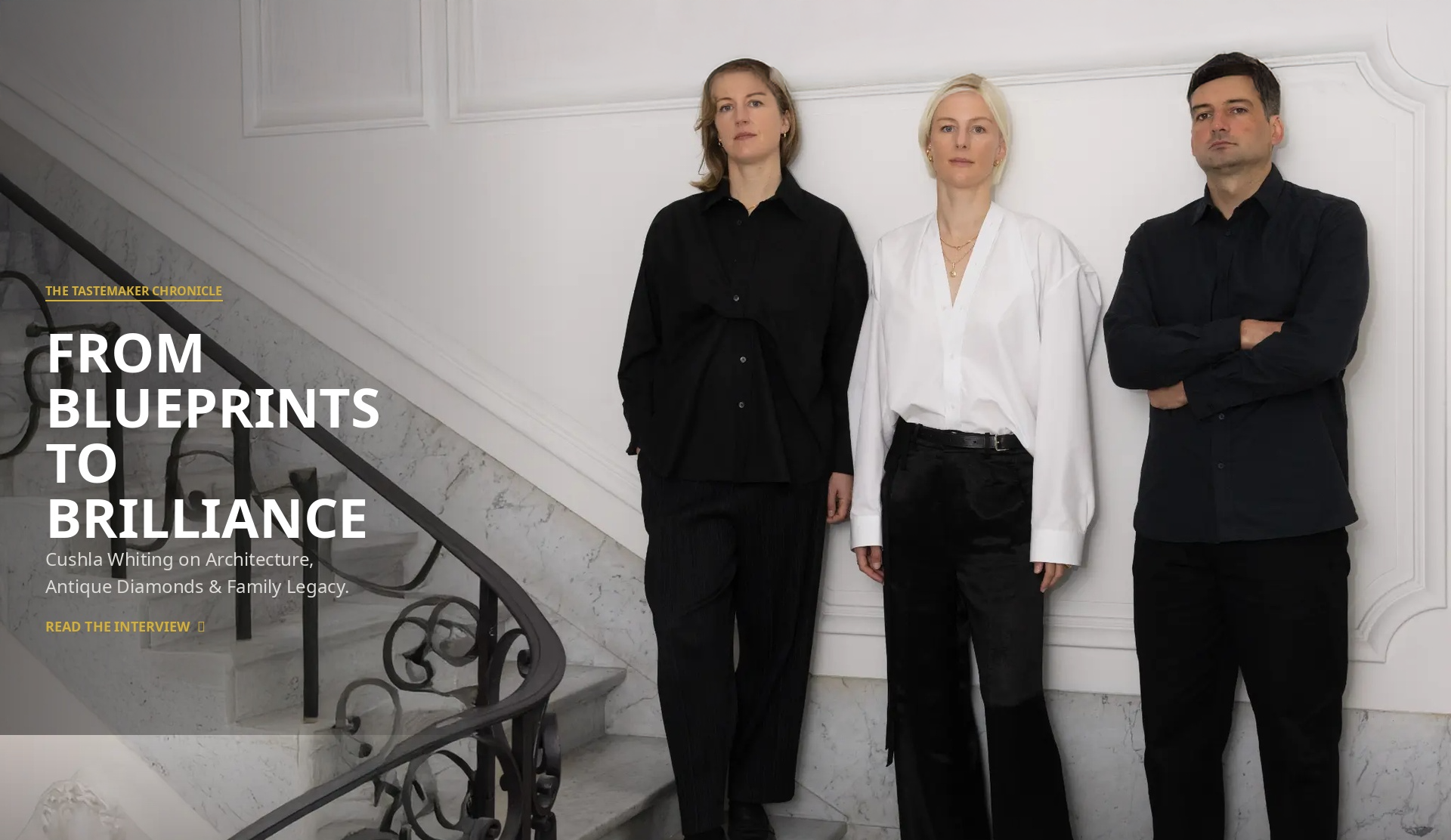
There is a distinct alchemy that occurs when the precision of architecture meets the romance of fine jewellery

1. You were an architect before launching the brand. How do the principles of architecture—form, light, and structure—influence the way you design a piece of jewellery?
My work is deeply influenced by Art Deco, modern and contemporary architecture and design. I’m drawn to bold, graphic forms, but also to the idea that, like architecture, jewellery needs to respond to its environment, in this case, the body. When I design, I’m always thinking about how a piece sits, moves, and interacts with the wearer. Light is also crucial: how it hits a gemstone or diamond, and how the design can best hero that stone. Attention to detail is everything in jewellery, and that’s something I really carried through from my architectural background.
2. Your father was an All Black who swapped the rugby pitch for the diamond trade. What’s the most valuable lesson he taught you about the world of gemstones?
Our dad was also a geologist, so he instilled in us a deep appreciation for the incredible journey of diamonds and gemstones, the fact that they’re millions of years old and shaped by extraordinary geological processes. He also taught us that, when it comes to diamonds, cut is everything. It’s what truly brings a stone to life.
3. The ‘La Cush’ cut is exclusive to your brand. Can you tell us the story behind its creation and what makes it so unique?
The La Cush Cut was developed by my brother Hamish, co-founder and gemologist at Cushla Whiting, after more than two decades of research into proportion, reflection, and light. It’s really the culmination of his lifelong fascination with antique diamonds and cutting techniques.

La Cush reinterprets the elegance of antique cuts through a contemporary lens. Rather than the high-intensity sparkle of modern brilliant cuts, it produces more subtle, structured flashes of light, something that feels more restrained and romantic. It doesn’t replicate the past, but rather interprets it, combining traditional character with modern precision and performance.
4. Your latest collection, COG, was inspired by the 1927 film Metropolis. How does a piece of silent cinema from nearly a century ago translate into a modern jewellery collection?
Metropolis was created during the Art Deco period, but the film imagines a futuristic city. Interestingly, that vision still feels timeless today. The architecture in the film have a sense of permanence that really resonates with me. That’s what I aim for in my jewellery as well: pieces that feel relevant now, but will still feel just as compelling in 100 years’ time.
5. You work closely with your siblings, Hamish and Anna. How do your individual strengths and perspectives come together to shape the Cushla Whiting brand?
We each bring very different strengths to the business, which is what makes it work so well. I’m the designer and creative director, Hamish focuses on gemstones and cutting, and Anna manages our client experience. Together, it creates a very balanced and considered approach.

6. What is one piece of jewellery you own that holds the most sentimental value, and what is its story?
My great grandfather’s pocket watch. It’s hand engraved with our family initials and has this beautiful, intricate cog mechanism inside. I love the craftsmanship; it really speaks to an older world of making which is very rare now. It’s also very weighty and I love that it feels so permanent and significant.
7. Antique diamonds are a signature of your work. What is it about these historical stones that you find so captivating?
There’s a real soul to antique diamonds. Each one was cut entirely by hand hundred(s) of years ago, so they carry the imprint of the maker’s skill and decisions, no two are ever quite the same. Their larger, softer facets create a more romantic, “blocky” play of light, which feels very different to the uniform brilliance of modern cuts.
They also come with a sense of history – you’re holding something that’s already lived a life, possibly across generations. And because so many have been recut over time, truly original antique stones are becoming increasingly rare, which makes them even more special.
8. What’s a common misconception people have about buying fine jewellery?
That it can be worn 24/7 without any care. Fine jewellery still needs to be looked after. Regular maintenance is important if you want pieces to last and be worn for generations.

9. How would you describe your personal, everyday jewellery style? Are you a minimalist or a maximalist?
I’m a minimalist at heart. I tend to wear fewer pieces, but I like them to feel striking and distinctive, something with presence rather than layering lots of smaller elements.
10. What do you hope a woman feels when she wears a piece of Cushla Whiting jewellery?
Confident, bold, and completely herself.


Leave a Reply